
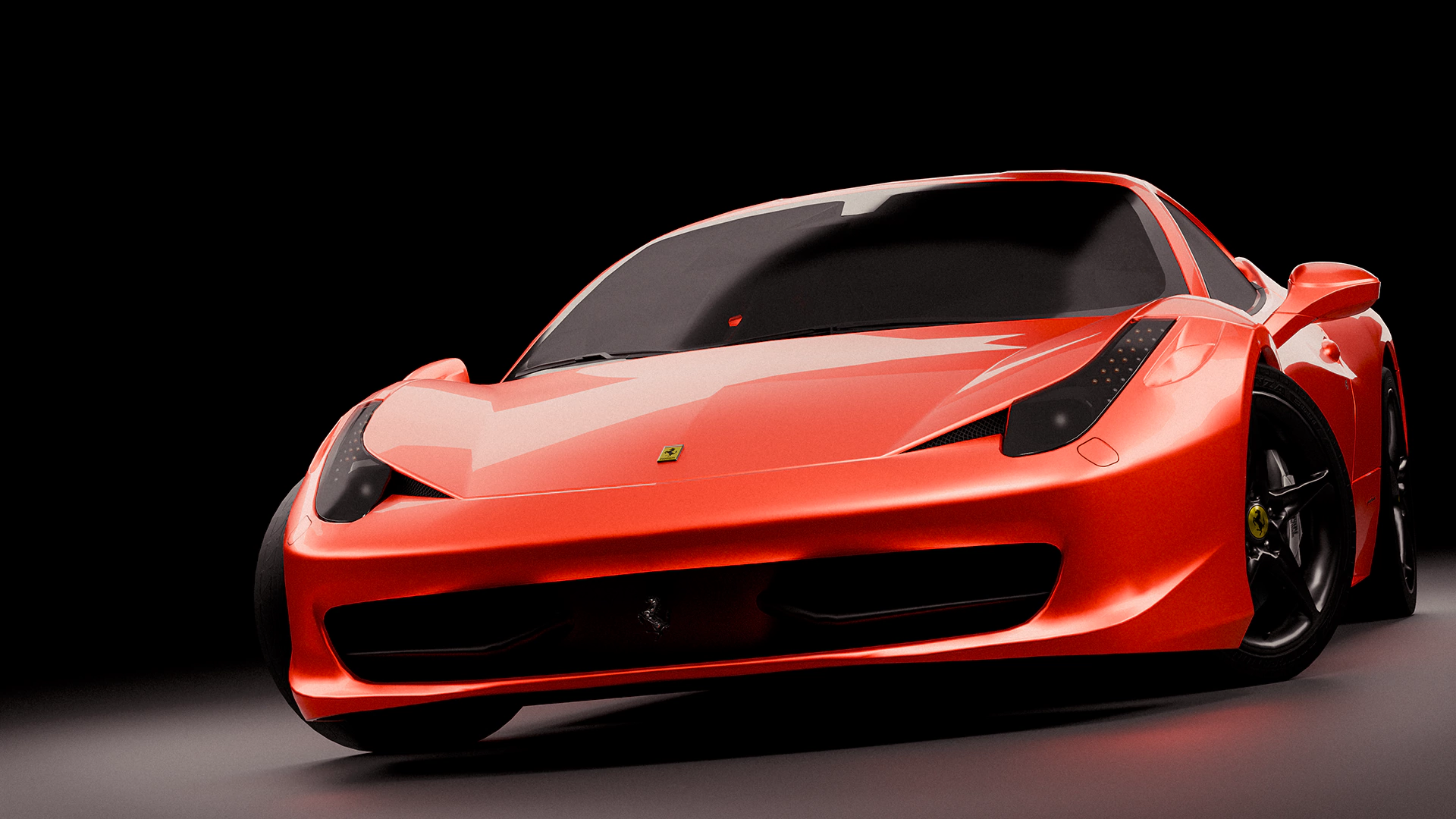
Ferrari 458 Italia 2011 Design Review & Specs
2026-06-29
2011 Ferrari 458 Italia - When Sharp Meets Soft
1. Overview
| Manufacturer | Ferrari |
| Production | 2009–2015 |
| Model Year | 2010–2015 |
| Assembly | Maranello, Italy |
| Layout | Rear mid-engine, rear-wheel drive |
| Body Style | 2-door coupé (458 Italia); 2-door retractable hardtop (458 Spider) |
| Chassis Code | F142 |
| Predecessor | Ferrari F430 |
| Successor | Ferrari 488 GTB |
The Ferrari 458 Italia is a mid‑engine V8 sports car that represents a defining moment for Ferrari’s design language. Introduced at the 2009 Frankfurt Motor Show, it replaced the F430 and instantly set a new benchmark for supercar styling. Its body is a masterful blend of sharp, technical creases and soft, organic volumes—a juxtaposition that gives the car both aerodynamic precision and emotional warmth. Designed by Pininfarina under the direction of Donato Coco, the 458 remains one of the most celebrated automotive designs of the 21st century.
2. History & Development
2.1 The F430 Successor
By the mid‑2000s, Ferrari’s F430—itself an evolution of the 360 Modena—was approaching the end of its lifecycle. The company began development of a completely new model (codenamed F142) that would not only surpass the F430 in performance but also redefine the visual identity of Ferrari’s mid‑engine V8 line.
The engineering team, led by the late Giuliano Niccolai, focused on three pillars: weight reduction, aerodynamic efficiency, and a naturally aspirated V8 that would deliver class‑leading power and a soundtrack to match. The result was a 4.5‑litre V8 producing 570 PS—the most powerful naturally aspirated V8 in Ferrari history at launch.
2.2 A New Design Philosophy
Ferrari commissioned Pininfarina to design the 458, continuing a partnership that had produced some of the most iconic Ferraris ever built. The exterior design was led by Donato Coco, then head of Pininfarina’s design centre. The brief was to create a car that was instantly recognisable as a Ferrari, yet distinct from any previous model.
Coco’s team took inspiration from aeronautics, Formula 1, and the organic shapes of nature. The design was refined in Ferrari’s own wind tunnel, resulting in a car with a drag coefficient of just 0.33 and significant downforce without a prominent rear wing. The exterior was launched in 2009, with the interior following a similar design‑led engineering philosophy—focusing on the driver and drawing directly from Ferrari’s F1 heritage.
2.3 The Name
The name “458” refers to the engine’s displacement (4.5 litres) and the number of cylinders (8). “Italia” was a tribute to the car’s home country and Ferrari’s national pride.
3. Design Team
| Role | Name |
|---|---|
| Exterior Design Director (Pininfarina) | Donato Coco |
| Head of Ferrari Design (internal) | Flavio Manzoni (oversight) |
| Interior Design | Pininfarina / Ferrari internal collaboration |
| Aerodynamics Lead | Luigi Arno (Ferrari) |
Donato Coco led the exterior design at Pininfarina, working closely with Ferrari’s own aerodynamics team to integrate functional features seamlessly into the sculpture. Flavio Manzoni, Ferrari’s chief design officer, later brought the 458’s design language into the 488 and other models.
4. Exterior Design Analysis
4.1 Stance & Proportions
| Dimension | Measurement |
|---|---|
| Overall Length | 4,527 mm (178.2 in) |
| Overall Width | 1,937 mm (76.3 in) |
| Overall Height | 1,213 mm (47.8 in) |
| Wheelbase | 2,650 mm (104.3 in) |
| Front Track | 1,672 mm (65.8 in) |
| Rear Track | 1,618 mm (63.7 in) |
| Ground Clearance | ~100 mm (3.9 in) |
The 458 is a classic mid‑engine proportion: a short, low nose, a long wheelbase with the cabin pushed forward, and a powerful rear haunch that houses the engine and transaxle. The front track is wider than the rear—a deliberate choice to improve front‑end grip and give the car a slightly aggressive, wide‑stance look. The car sits extremely low, with just 100 mm of ground clearance, reinforcing its race‑bred character.
4.2 The Language: Sharp Meets Soft
Unlike the rounded volumes of the Porsche 993 or Toyota Supra MK4, the 458 uses a deliberate visual tension between sharp, technical lines and soft, organic surfaces.
- Front: The bonnet carries crisp creases that run from the windscreen to the nose, but the main central air intake is a wide, rounded oval, and the nose itself is convex and gently curved. Directly below, the front splitter and canards slice back into hard edges.
- Shoulder line: A taut, precise line runs from the front wing to the rear, but it swells into a soft, muscular volume as it passes over the rear wheel arch. It is both a sharp edge and a three‑dimensional swell.
- Rear flanks: The surface between the shoulder line and the lower sill is gently concave, adding depth and shadow without any harsh creasing.
This juxtaposition is not conflict—it is controlled tension. It gives the car a sense of precision and technical intent without becoming cold or clinical. The shapes communicate both aerodynamics (sharp edges for downforce and airflow management) and emotion (rounded volumes that feel alive).
4.3 Front Fascia
The front end is dominated by the large, two‑part central grille that incorporates radiators and air intakes. The central opening is a soft, almost elliptical shape, flanked by two smaller intakes for the front brakes. The bonnet features a pronounced central depression and two lateral creases that direct air upwards and over the windscreen.
The headlights are slim, swooping units that integrate LED daytime running lights—a first for Ferrari. They are set into the front fenders, which are gently flared, and their shape echoes the aerodynamic theme of the car. Below the headlights, additional air intakes feed the radiators and cool the brakes.
4.4 Side Profile & The Hybrid Shoulder
The side is where the sharp‑soft tension is most evident. The lower sill has a deep, sharp cut that creates a dramatic shadow, while the door surface is gently convex. The shoulder line is a taut crease at the front, but as it moves toward the rear, it becomes a soft, swelling curve that defines the massive rear haunch. The rear haunch itself has a bold, concave indentation behind the side air intake, which channels air to the engine. This sculpted volume, combined with the sharp upper edge, gives the car a muscular yet refined appearance.
4.5 Rear Design & Visible Aerodynamics
The rear is a tour de force of functional integration:
- Air channel: Behind the rear mesh, a visible air channel tunnels through the body, extracting hot air from the engine bay and improving aerodynamic efficiency. This technique—making aerodynamic elements visible—was also used on the Ford GT and Lotus Evija, but the 458 popularised it in the sports car segment.
- Triple exhaust: Three centrally positioned exhaust outlets—a signature of the 458—are arranged in a triangular pattern. This is not only visually distinctive but also helps reduce backpressure and improve exhaust flow.
- Trapezoidal negative space: The exhausts are set into a large trapezoidal recess that carves into the rear diffuser, creating a dramatic void between the two taillights. This negative space is a bold design choice that makes the rear look wide, low, and purposeful.
- Taillights: The lights themselves are compact, single‑unit clusters that incorporate brake, indicator, and reverse functions. They are simple and unfussy, contributing to the rear’s clean graphic.
4.6 A Note on Logos (Design Critique)
The 458 carries approximately ten prominent Ferrari shields and logos: on the front grille, the bonnet, the front fenders, the rear bumper, and each wheel centre. From a pure design standpoint, this can feel a little heavy. The shape language is so strong, so unmistakably Ferrari, that the badges almost compete with the sculpture. It is a reminder that even in elite design, marketing and branding pressures can nudge the final result. A more restrained application of logos would have allowed the pure form to speak even more clearly.
4.7 Wheel Design
| 458 Italia | 458 Speciale | |
|---|---|---|
| Wheel Size (Front) | 8.5J x 20 | 9J x 20 |
| Wheel Size (Rear) | 10.5J x 20 | 11J x 20 |
| Tyres (Front) | 235/35ZR20 | 245/35ZR20 |
| Tyres (Rear) | 295/35ZR20 | 305/30ZR20 |
The standard 458 wheels use low‑profile, five‑spoke star designs that visually push the mass outward. This does two things: it makes the wheel feel lighter and more delicate, and it exposes the carbon‑ceramic brake rotors as a visual element. The hardware becomes ornament, reinforcing the car’s high‑tech, race‑inspired aesthetic. Optional forged wheels are also available, with even more open designs to showcase the brakes.
5. Interior Design
5.1 The Formula 1 Connection
The interior of the 458 is a direct translation of Ferrari’s Formula 1 heritage into a road‑going cockpit. The steering wheel is the centrepiece—a design that sits between a traditional round wheel and an open‑top F1 wheel. It features integrated shift lights at the top, which flash sequentially as the revs approach the redline. This is not decoration; it is a deliberate psychological link to Ferrari’s racing identity, putting the driver in a race‑car mindset from the moment they grip the wheel.
The wheel also houses the start button and the “manettino” dial, which allows the driver to adjust traction control, suspension, and gearbox response—directly borrowed from F1.
5.2 Materials & Ergonomics
- Carbon fibre dominates the dash, door panels, and centre console, keeping weight low and reinforcing the technical theme.
- Colour palette stays neutral (black, charcoal, grey, with occasional contrasting stitching) to avoid distraction.
- The instrument cluster is a large, central analogue tachometer flanked by two digital displays; this layout keeps vital information in the driver’s direct line of sight.
- The centre console is simple and elevated, housing climate and audio controls, but the main focus is on the driving controls.
5.3 Seating & Comfort
The seats are deeply sculpted, providing excellent lateral support for spirited driving, while still being comfortable enough for long journeys. Optional full‑leather or Alcantara trims are available, and the seats can be heated.
5.4 Practicality
The 458 offers a small front luggage compartment (approximately 230 litres) and a little stowage behind the seats. It is not a GT car, but it is surprisingly usable for a mid‑engine supercar.
6. Chassis & Suspension
6.1 Aluminium Space Frame
The 458 uses a completely new aluminium space‑frame chassis, developed jointly with Alcoa. It is 20% lighter than the F430’s steel‑based structure and offers 15% more torsional rigidity. The chassis was designed to accommodate the mid‑engine layout and the new 7‑speed dual‑clutch transmission, which sits behind the engine.
6.2 Suspension & Brakes
| Component | Specification |
|---|---|
| Front Suspension | Double wishbone with coil springs, anti‑roll bar |
| Rear Suspension | Multi‑link (double wishbone) with coil springs, anti‑roll bar |
| Front Brakes | 6‑piston monobloc calipers, 398 x 36 mm carbon‑ceramic discs |
| Rear Brakes | 4‑piston monobloc calipers, 360 x 32 mm carbon‑ceramic discs |
| Brake Assist | ABS with EBD (Electronic Brakeforce Distribution) |
| Wheelbase | 2,650 mm |
The carbon‑ceramic brakes were standard on the 458, providing fade‑free stopping power. The suspension geometry was tuned for agility and quick response, with Ferrari’s “Magnetorheological” adaptive dampers available as an option (later becoming standard).
6.3 Weight & Balance
| Curb Weight | |
|---|---|
| Dry Weight | 1,380 kg (3,042 lb) |
| Curb Weight (with fluids) | ~1,485 kg (3,274 lb) |
| Weight Distribution | 42% Front / 58% Rear |
The rear‑biased distribution contributes to the car’s traction and handling dynamics, typical of mid‑engine supercars.
6.4 Steering
| Component | Specification |
|---|---|
| Type | Rack and pinion, electric power steering (EPS) |
| Turning Radius | 5.6 m (18.4 ft) |
Ferrari introduced electric power steering for the first time on the 458, tuned to provide natural feel and high levels of feedback.
7. Engine & Performance
7.1 The Naturally Aspirated V8
The 458’s heart is the F136 FB engine—a 4.5‑litre naturally aspirated V8, derived from the F136 family that also powered the F430. It was completely reworked for the 458 with:
- A flat‑plane crankshaft (180‑degree angle) for a distinctive, high‑revving character
- Direct fuel injection (the first Ferrari V8 with this technology)
- Variable intake length and exhaust valve timing
- High‑pressure injectors and advanced engine management
The result is a power unit that produces 570 PS at 9,000 rpm—a specific output of 127 PS per litre, one of the highest for a naturally aspirated production engine at the time. The engine sound is a mechanical symphony, with a sharp, metallic rasp that becomes a wail as the revs rise.
7.2 Engine Specifications
| Specification | Detail |
|---|---|
| Engine Code | F136 FB |
| Configuration | 90° V8, 32‑valve DOHC, naturally aspirated |
| Displacement | 4,499 cc (274.5 cu in) |
| Bore × Stroke | 94.0 mm × 81.0 mm |
| Compression Ratio | 12.5:1 |
| Redline | 9,000 rpm (power peaks at 9,000) |
| Fuel System | Direct injection, multi‑point |
| Fuel Tank Capacity | 86 L (22.7 US gal) |
7.3 Power & Torque
| Metric | Value |
|---|---|
| Maximum Power | 570 PS (419 kW; 562 bhp) @ 9,000 rpm |
| Maximum Torque | 540 N·m (398 lb·ft) @ 6,000 rpm |
| Torque Curve | 80% of peak torque available from 3,000 rpm |
7.4 Transmission
The 458 was the first Ferrari road car to feature a 7‑speed dual‑clutch transmission (DCT) as standard, replacing the F430’s single‑clutch F1 gearbox. It provided lightning‑fast shifts (down to 60 milliseconds) and improved efficiency. The gearbox is mounted in a transaxle configuration behind the engine, contributing to the car’s balanced weight distribution.
| Gear | Ratio |
|---|---|
| 1st | 3.846 |
| 2nd | 2.632 |
| 3rd | 1.895 |
| 4th | 1.474 |
| 5th | 1.211 |
| 6th | 1.000 |
| 7th | 0.843 |
| Reverse | 2.875 |
| Final Drive | 4.375 |
7.5 Performance Figures
| Metric | Value |
|---|---|
| 0–60 mph | 3.3 seconds (3.0 seconds with launch control) |
| 0–100 mph | 6.9 seconds |
| Quarter mile | 10.9 seconds @ 130 mph |
| 0–200 km/h (124 mph) | 10.5 seconds |
| Top Speed | 202 mph (325 km/h) |
| Fuel Economy (combined) | ~18 mpg (US) |
| CO₂ Emissions | 307 g/km |
8. Complete Specifications (458 Italia, 2011)
Dimensions
| Overall Length | 4,527 mm (178.2 in) |
| Overall Width | 1,937 mm (76.3 in) |
| Overall Height | 1,213 mm (47.8 in) |
| Wheelbase | 2,650 mm (104.3 in) |
| Front Track | 1,672 mm (65.8 in) |
| Rear Track | 1,618 mm (63.7 in) |
| Ground Clearance | 100 mm (3.9 in) |
Weights & Capacities
| Dry Weight | 1,380 kg (3,042 lb) |
| Curb Weight | 1,485 kg (3,274 lb) |
| Gross Vehicle Weight | 1,680 kg (3,704 lb) |
| Seating Capacity | 2 |
| Luggage Volume (front) | 230 L (8.1 cu ft) |
Engine & Performance Summary
| Metric | Value |
|---|---|
| Engine | F136 FB 4.5L V8, naturally aspirated |
| Power | 570 PS (562 bhp) @ 9,000 rpm |
| Torque | 540 N·m (398 lb·ft) @ 6,000 rpm |
| Transmission | 7‑speed dual‑clutch automatic |
| Drive | Rear‑wheel drive |
| 0‑60 mph | 3.3 seconds |
| Top Speed | 202 mph |
9. Variants & Evolution
9.1 458 Italia (2009–2015)
The standard coupé model, as detailed above.
9.2 458 Spider (2011–2015)
Launched in 2011, the Spider features an all‑aluminium retractable hardtop that folds in 14 seconds. It retains the same engine and performance figures, with only a slight weight increase (about 50 kg). The rear air channel and triple exhaust are preserved, though the rear styling is slightly adapted to accommodate the folding mechanism.
9.3 458 Speciale (2013–2015)
A track‑focused lightweight variant with:
- Increased power: 605 PS (445 kW; 597 bhp) from the same 4.5L V8
- Weight reduction: 90 kg lighter (1,290 kg dry)
- Active aerodynamics (front “plexiglass” wing and rear spoiler)
- Upgraded suspension, brakes, and tyres
- Distinctive exterior stripes and aerodynamic elements
- Produced in limited numbers (~2,000 units total)
9.4 458 Speciale A (2014–2015)
A limited‑run (499 units) open‑top version of the Speciale, with a folding soft top.
9.5 458 Italia GT2 / GT3
The competition versions, used in endurance racing, featuring extensive aerodynamic modifications and weight reduction.
10. Cultural Impact & Legacy
10.1 A Benchmark for Modern Supercar Design
The 458 Italia set a new standard for supercar design when it debuted. Its blend of sharp, technical lines and organic, sensual surfaces influenced a generation of sports cars from other manufacturers, including the McLaren 12C, Lamborghini Huracán, and even later Ferraris like the 488 and F8 Tributo.
10.2 The Last Naturally Aspirated V8 Ferrari (ish)
With the 488 GTB switching to twin‑turbo power, the 458 became the last Ferrari V8 to be naturally aspirated (until the 296 GTB’s V6 hybrid arrived). Enthusiasts cherish the 458 for its linear power delivery, high‑revving character, and sublime soundtrack—all of which are intrinsic to its design and engineering philosophy.
10.3 Design Awards & Recognition
The 458 won numerous design awards, including the “Red Dot: Best of the Best” and “iF Product Design Award.” It was praised for its aerodynamic integration, its purity of form, and its ability to be both aggressive and elegant.
10.4 Why It Still Works
The 458 remains a design milestone because it balances two seemingly opposite qualities: technical precision and emotional warmth. The sharp lines communicate performance intent; the soft volumes give it soul. In a world where supercars are increasingly dominated by overt aero devices and frantic surface complexity, the 458 stands as a reminder that restraint—and a clever interplay of shapes—can produce something that is simultaneously modern and timeless.
11. Poster
Download the official Asphalt Aesthetics Episode 1 poster: