
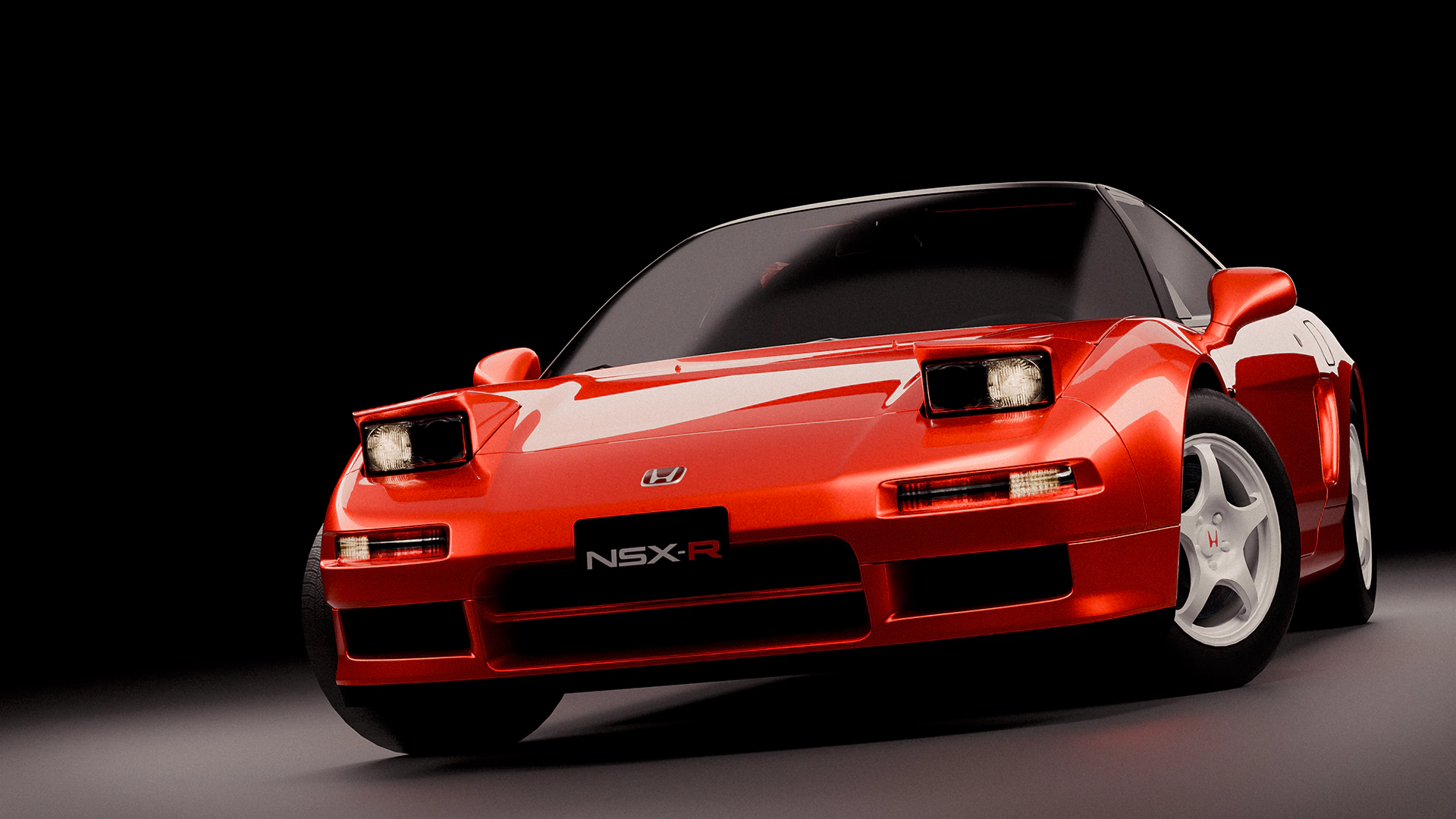
Honda NSX 1992 Design Review & Specs
2026-06-19
1992 Honda NSX - A Study in Functional Elegance
1. Overview
| Manufacturer | Honda (sold as Acura NSX in North America) |
| Production | August 1990 – November 30, 2005 (first generation) |
| Model Year | 1991–2005 |
| Assembly | Takanezawa R&D Plant, Tochigi, Japan (1990–2004); Suzuka R&D Plant, Japan (2004–2005) |
| Layout | Rear mid-engine, rear-wheel drive |
| Body Style | 2-door coupé; 2-door targa top (NSX-T, 1995+) |
| Chassis Code (1992 Model) | NA1 (3.0L C30A engine) |
| Class | Sports car (S-segment) |
The first-generation Honda NSX (New Sportscar eXperimental) is a two-seater, mid-engine sports car that redefined what a supercar could be — not through aggressive styling or outrageous performance figures, but through restraint, precision, and a philosophy of functional minimalism.
2. History & Development
2.1 The HP-X Concept (1984)
The NSX story begins in 1984, when Honda commissioned the legendary Italian design house Pininfarina to create a mid-engine sports car concept. The result was the HP-X (Honda Pininfarina eXperimental), a sleek, low-slung prototype powered by a mid-mounted 2.0L V6 engine. The concept was first shown at the Turin Auto Show that same year.
2.2 From Concept to Production
After Honda committed to the project, management made it clear: the new car had to be as fast as anything coming from Italy and Germany. The original performance target was the Ferrari 328 — but as development progressed, that target was revised to the newer Ferrari 348.
The HP-X concept evolved into a prototype called the NS-X, a name that stood for "New," "Sportscar," and "eXperimental." The production model launched as the Honda NSX in 1990 (1991 model year).
2.3 Development Philosophy
Honda's goal was audacious: create a supercar that could match or exceed Ferrari's performance while offering Honda's legendary reliability and daily usability — at a lower price.
The development team, led by Executive Chief Engineer Shigeru Uehara, took an unconventional approach. Instead of chasing ever-higher power figures, they focused on weight reduction, chassis rigidity, and handling precision.
2.4 Ayrton Senna's Involvement
Perhaps the most famous chapter in the NSX's development is the involvement of Formula 1 World Champion Ayrton Senna. Senna tested prototypes at the Suzuka Circuit and was instrumental in convincing Honda to stiffen the chassis for better handling precision. His feedback helped transform the NSX from a competent sports car into a truly exceptional driver's machine.
2.5 The NSX's Influence
The NSX's impact on automotive design cannot be overstated. Gordon Murray, designer of the legendary McLaren F1, famously stated that when he drove an NSX, "all existing benchmark cars vanished from my mind." He used the NSX as a benchmark for the McLaren F1's chassis development, calling the design "monumental" for sports car design. Murray was so impressed that he bought an NSX for personal use and drove it for 75,000 kilometres.
3. Design Team
| Role | Name |
|---|---|
| Chief Designer (Exterior) | Ken Okuyama (1987) |
| Chief Designer | Masahito Nakano (1987) |
| Executive Chief Engineer | Shigeru Uehara (1988) |
| Designer | James Stevens (1988) |
The NSX was designed by a team led by Chief Designer Masahito Nakano and Executive Chief Engineer Shigeru Uehara. Ken Okuyama, who had previously worked on the HP-X concept at Pininfarina, served as Chief Designer for the production model.
Okuyama extensively researched the F-16 fighter jet and incorporated elements of it into the NSX's design — particularly the cockpit's 360-degree visibility and the aerodynamic glasshouse. The F-16's influence extended to the exterior design as well, establishing the conceptual goals of the NSX.
4. Exterior Design Analysis
4.1 Stance & Proportions
| Dimension | Measurement |
|---|---|
| Overall Length | 4,430 mm (174.4 in) |
| Overall Width | 1,810 mm (71.3 in) |
| Overall Height | 1,170 mm (46.1 in) |
| Wheelbase | 2,530 mm (99.6 in) |
| Front Track | 1,510 mm (59.4 in) |
| Rear Track | 1,530 mm (60.2 in) |
| Minimum Ground Clearance | 135 mm (5.3 in) |
The NSX is compact and mid-engine — a short nose and low engine bay give it a distinctly planted stance. The wheel arches barely protrude, and the hood and fenders are shaped with broad, clean surfaces and almost no sharp character lines. Everything feels deliberately underdrawn.
The black roof — regardless of body colour — pulls the whole car visually lower. Park it next to a contemporary Porsche 993, and it feels noticeably more planted — not because the numbers say so, but because the design tells you it is.
4.2 Functional Minimalism
The NSX's design philosophy can be summed up in one phrase: every opening, every form, serves a performance requirement — but nothing is overstyled.
- Front intakes: A simple outward extrusion. No interlocking blades, no fake mesh drama.
- Side vents: The vent behind the door feeds the engine, then fades almost flat as it moves forward over the door — so nothing pokes out, and the door doesn't need a deep recess.
- Rear bumper: Understated, logical, clean.
This restraint is what makes the design timeless. There are no era-specific gimmicks — no tailfins, no excessive creases.
4.3 Symmetry & Visual Quiet
The NSX plays a quiet trick with symmetry. Beyond the usual left-right balance, there's a strong top-down symmetry at the rear:
- Tail lights: Run as one uninterrupted piece
- Rear wing: Integrated into the body rather than tacked on
- Windshield wipers: Hidden under the hood bulge
The design team erased anything that would break the calm surface.
4.4 Pop-Up Headlights
When closed, the pop-up headlights keep the nose low and uninterrupted, giving the car a sleepy, focused face. Open, they add theatre without ruining the clean front graphic. They're functional jewellery.
4.5 Wheel Design
The five-spoke wheel design became Honda's sporty language for nearly a decade — its DNA can be seen in the 1997 Civic Type R (EK9) wheel, just with six spokes. It's a masterclass in a single design element setting a family identity without feeling dated.
| Wheel Specs (1990–1993) | |
|---|---|
| Front | 205/50ZR15 |
| Rear | 225/50ZR16 |
5. Interior Design
5.1 Cockpit Philosophy
The interior design thinking gets even quieter — but sharper. The dashboard sweeps across in an all-embracing arc with a single pod sprouting from it to house the instrument cluster. Controls follow typical Honda pragmatism — big buttons for necessary functions — giving the interior a simple and surprisingly modern look.
5.2 Ergonomics
| Interior Dimension | Measurement |
|---|---|
| Interior Length | 970 mm |
| Interior Width | 1,460 mm |
| Interior Height | 980 mm |
- Rear visibility: The flat rear deck gives exceptional rear visibility; blind spots are nearly nonexistent.
- Center console: Stripped of button clutter; almost everything lives in the main instrument binnacle, close to your line of sight.
- Shift lever: On automatic cars, a distinctive straight-gate pistol grip; on manuals, a titanium knob. Both were sculpted for quick, eyes-up interaction.
- Door console: Angled slightly toward the driver, reducing reach and distraction.
These aren't decorations. They're ergonomic design choices that, decades later, still feel thoughtful and modern. That's the difference between styling and real design.
6. Chassis & Suspension
6.1 The Aluminum Monocoque
The NSX was the world's first production car to feature an all-aluminum monocoque chassis and body. This revolutionary extruded aluminum alloy frame and body saved nearly 200 kg (441 lb) compared to a steel equivalent. The aluminum suspension components saved a further 20 kg.
6.2 Suspension
| Component | Specification |
|---|---|
| Front Suspension | Double wishbone (independent) |
| Rear Suspension | Double wishbone (independent) |
| Control Arms | Aluminum |
| Stabilizer | Torsion bar (front and rear) |
The NSX was engineered with a fully independent double-wishbone suspension on all four corners, aluminum control arms, and a focus on low unsprung weight. Honda pulled no punches — it's essentially a Formula car for the street in layout and geometry.
6.3 Weight & Balance
| Curb Weight (5MT) | 1,350 kg (2,976 lb) |
| Curb Weight (4AT) | 1,390 kg (3,064 lb) |
| Weight Distribution | ~42% Front / 58% Rear |
This rear-biased setup gives the NSX its legendary balance.
6.4 Brakes
| Component | Specification |
|---|---|
| Front Brakes | Vented disc, hydraulic |
| Rear Brakes | Vented disc, hydraulic |
| Booster | Vacuum-assisted |
| Brake Assist System | Anti-lock Braking System (ABS) |
6.5 Steering
| Component | Specification |
|---|---|
| Type | Rack and pinion |
| Power Assist | Electric power steering (4AT); manual (5MT) |
| Minimum Turning Radius | 5.8 m |
7. Engine & Performance
7.1 The C30A Engine
| Specification | Detail |
|---|---|
| Engine Code | C30A |
| Configuration | 90° V6, naturally aspirated |
| Displacement | 2,977 cc (181.7 cu in) |
| Bore × Stroke | 90.0 mm × 78.0 mm |
| Compression Ratio | 10.2:1 |
| Valvetrain | DOHC, 24 valves, belt-driven |
| VTEC | Variable Valve Timing and Lift Electronic Control |
| Fuel System | Honda PGM-FI electronic fuel injection |
| Fuel Tank Capacity | 70 L (18.5 US gal) |
| Oil Capacity | 6.3 L |
7.2 The VTEC Revolution
The C30A was the first Honda engine to combine VTEC with a DOHC V6 configuration. Honda initially planned to use a SOHC V6 based on the C25A from the Legend, but the success of VTEC on the 1989 Integra prompted a last-minute shift to DOHC.
The engine featured:
- Forged pistons for high-strength durability
- Titanium connecting rods to reduce reciprocating weight, allowing an 8,000 rpm redline
- Transverse mounting with a 5-degree rearward tilt for optimal packaging
7.3 Performance Figures
| 5-Speed Manual | 4-Speed Automatic | |
|---|---|---|
| Maximum Power (net) | 280 PS (206 kW; 276 hp) @ 7,300 rpm | 265 PS (195 kW; 261 hp) @ 6,800 rpm |
| Maximum Torque (net) | 30.0 kg·m (294 N·m; 217 lb·ft) @ 5,400 rpm | 30.0 kg·m (294 N·m; 217 lb·ft) @ 5,400 rpm |
| 0–60 mph | ~5.7 seconds | — |
| Top Speed | ~168 mph (270 km/h) | — |
| Fuel Economy (10-mode) | 8.3 km/L | 7.1 km/L |
| Fuel Economy (60 km/h constant) | 16.0 km/L | 15.3 km/L |
7.4 Transmission
| 5-Speed Manual | 4-Speed Automatic | |
|---|---|---|
| Type | Constant-mesh, floor shift | 3-element, 1-stage, 2-phase (with lock-up clutch) |
| 1st Gear | 3.071 | 2.611 |
| 2nd Gear | 1.952 | 1.466 |
| 3rd Gear | 1.400 | 1.025 |
| 4th Gear | 1.033 | 0.777 |
| 5th Gear | 0.771 | — |
| Reverse | 3.186 | 1.909 |
| Final Drive Ratio | 4.062 | 4.066 |
8. Complete Specifications (1992 NA1)
Dimensions
| Overall Length | 4,430 mm (174.4 in) |
| Overall Width | 1,810 mm (71.3 in) |
| Overall Height | 1,170 mm (46.1 in) |
| Wheelbase | 2,530 mm (99.6 in) |
| Front Track | 1,510 mm (59.4 in) |
| Rear Track | 1,530 mm (60.2 in) |
| Minimum Ground Clearance | 135 mm (5.3 in) |
| Interior Length | 970 mm |
| Interior Width | 1,460 mm |
| Interior Height | 980 mm |
Weights
| Curb Weight (5MT) | 1,350 kg (2,976 lb) |
| Curb Weight (4AT) | 1,390 kg (3,064 lb) |
| Seating Capacity | 2 |
Performance
| Engine | C30A 3.0L DOHC VTEC V6 |
| Power (5MT) | 280 PS @ 7,300 rpm |
| Power (4AT) | 265 PS @ 6,800 rpm |
| Torque | 30.0 kg·m @ 5,400 rpm |
| 0–60 mph | ~5.7 seconds |
| Top Speed | ~168 mph |
9. Variants & Evolution
9.1 Major Chassis Codes
| Code | Years | Engine | Transmission |
|---|---|---|---|
| NA1 | 1990–1996 | 3.0L C30A V6 | 5-speed manual / 4-speed automatic |
| NA2 | 1997–2005 | 3.2L C32B V6 | 6-speed manual |
9.2 Key Variants
| Variant | Description |
|---|---|
| NSX-T | Targa top version introduced in 1995 |
| NSX-R | Japan-only lightweight, track-focused model |
| Zanardi Edition | USDM lightweight limited run (1999 only) |
9.3 Facelift (2002)
The 2002 facelift brought:
- Fixed headlights (replacing pop-ups)
- Revised front and rear bumpers
- Updated wheel designs
10. Cultural Impact & Legacy
10.1 A Supercar That Doesn't Shout
In silhouette, the NSX often gets compared to mid-engine Ferraris of the era — but the Japanese approach swapped Latin drama for surface purity. It's a supercar that doesn't need to shout. It trusts that the proportions, the stance, and the honesty of the forms will be enough.
10.2 The Daily Supercar
Unlike its European rivals, the NSX could comfortably handle everyday life. It proved that supercar performance didn't need to come with temperamental maintenance. Ferraris, Lamborghinis, and even Porsches of the time were truculent beasts that demanded concentration — and a bit of heft. The NSX offered excitement without the compromise.
10.3 Inspiration for Generations
- Gordon Murray used the NSX as the benchmark for the McLaren F1's chassis
- The design language influenced Honda's sporty lineup for years, including the Civic Type R (EK9)
- The engineering philosophy — lightweight, mid-engine, naturally aspirated — became a template for the modern sports car
10.4 Modern Recognition
The NSX has aged so gracefully that, decades later, a light refresh of the headlights and bumpers can be enough to keep it looking current. That's the real lesson: when you prioritise design fundamentals over fashion, you create something that outlasts trends. The NSX didn't just age well — it made aging irrelevant.
11. Poster
Download the official Asphalt Aesthetics Episode 1 poster: