
Lexus LFA 2011 Design Review & Specs
2026-07-02
2011 Lexus LFA - Sharp Edges and a Soundtrack from the Gods
1. Overview
| Manufacturer | Lexus (Toyota) |
| Production | 2010–2012 |
| Model Year | 2011–2012 |
| Assembly | Motomachi Plant, Toyota City, Japan |
| Layout | Front mid-engine, rear-wheel drive |
| Body Style | 2-door coupé |
| Chassis Code | LFA |
| Class | Sports car / Supercar |
| Predecessor | None |
| Successor | None (spiritual successor: Lexus LC 500) |
The Lexus LFA is a front-mid-engine, rear-wheel-drive supercar developed over nearly a decade by Toyota's Lexus division. It was one of the most ambitious and expensive projects in automotive history—a no-compromise halo car designed to showcase Lexus's engineering and design capabilities. With its 4.8-litre naturally aspirated V10, a carbon fibre monocoque, and an exhaust note famously tuned by Yamaha, the LFA remains a singular achievement in Japanese automotive design. Its exterior is a masterclass in controlled aggression, while its interior—though ambitious—drew criticism for ergonomic and aesthetic inconsistencies.
2. History & Development
2.1 Genesis (2000–2005)
The LFA project, codenamed P280, began in 2000 under the leadership of chief engineer Haruhiko Tanahashi. The goal was ambitious: create a supercar that could compete with the best from Ferrari, Lamborghini, and Porsche, while showcasing Toyota's advanced technology and craftsmanship. The initial concept used an aluminium body and a V8 engine, but as development progressed, the team decided to push further.
2.2 The Carbon Fibre Revolution
By 2003, the project had been redefined. Lexus decided to use carbon fibre reinforced plastic (CFRP) for the body and monocoque—a first for a Japanese production car. This required Toyota to build a dedicated carbon fibre manufacturing facility and develop new production techniques. The CFRP body, combined with aluminium subframes, resulted in a lightweight structure with exceptional rigidity.
2.3 The V10 Engine
The engine was another area of obsessive development. Initially targeting a V8, the team eventually settled on a 4.8-litre naturally aspirated V10. The engine was developed in collaboration with Yamaha, who also helped tune the exhaust note. The result was a high-revving unit with a 9,000 rpm redline and a sound that has been compared to the wail of a Formula 1 car.
2.4 Public Debut and Production
The LFA was first shown as a concept at the 2005 Detroit Auto Show. A production version followed in 2009, with deliveries beginning in 2010. Initially priced at $375,000, the LFA was built in extremely limited numbers—only 500 units were produced between 2010 and 2012. Each car was built by hand by a dedicated team of technicians, and buyers could customise their cars through a bespoke "LFA Design Studio" programme.
3. Design Team
| Role | Name |
|---|---|
| Chief Engineer | Haruhiko Tanahashi |
| Exterior Design | Lexus Design Division (led by Takeshi Tanabe) |
| Interior Design | Lexus Design Division |
| Sound Tuning | Yamaha (acoustic engineering) |
The LFA's exterior was designed by Lexus's internal design team under the direction of Takeshi Tanabe. The design language was a departure from Lexus's earlier, more conservative styling, introducing sharp angles and aggressive proportions that would later influence the entire Lexus lineup.
4. Exterior Design Analysis
4.1 Stance & Proportions
| Dimension | Measurement |
|---|---|
| Overall Length | 4,505 mm (177.4 in) |
| Overall Width | 1,895 mm (74.6 in) |
| Overall Height | 1,220 mm (48.0 in) |
| Wheelbase | 2,605 mm (102.6 in) |
| Front Track | 1,580 mm (62.2 in) |
| Rear Track | 1,570 mm (61.8 in) |
| Ground Clearance | 115 mm (4.5 in) |
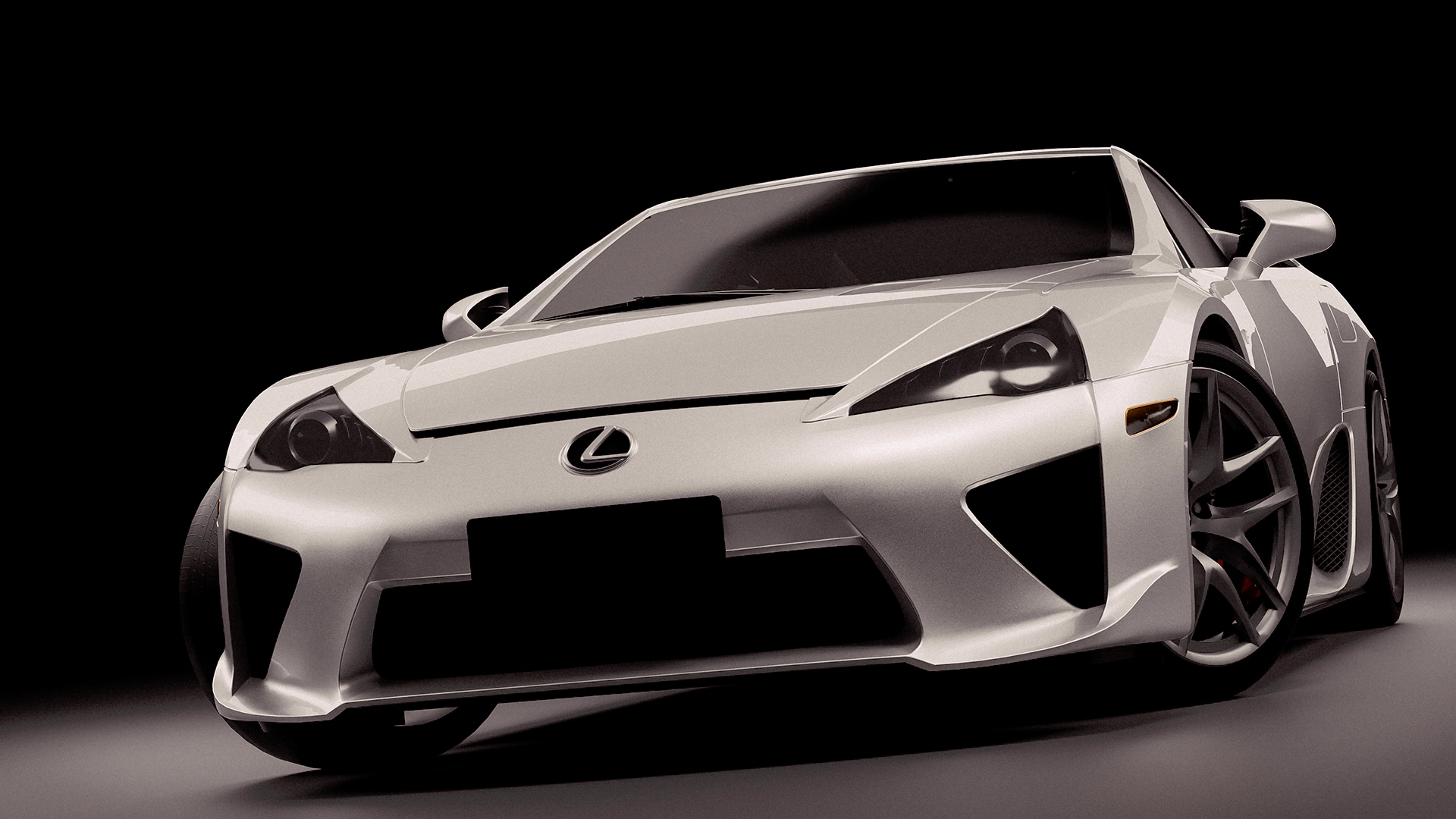
The LFA's proportions are classic front-mid-engine: a long, low nose that houses the engine behind the front axle, a cabin pushed slightly rearward, and a short, muscular tail. The wheelbase is long for a supercar, giving the car a stretched, stable appearance. The front track is slightly wider than the rear, enhancing front-end grip and visual width. The car is remarkably low, with a ground clearance of just 115 mm, contributing to its planted, ground-hugging stance.
4.2 Exterior Language: Sharp but Controlled
The LFA's body is built from sharp, angular surfaces—but they're used with immense restraint. The lines are crisp, yet nothing feels spiky or overwrought. The aggression is precise, not chaotic. This is a distinct philosophy from the rounded bulk of the Supra MK4 or the soft tension of the Porsche 993. It is a distinctly modern Japanese sharpness, governed by a deep sense of control.
Key characteristics include:
- Flat, broad surfaces: The bonnet and rear flanks are predominantly flat, allowing light to glide across the body without interruption.
- Crisp character lines: Where lines exist, they are sharp and deliberate—a contrast to the softer, blended forms of earlier Japanese icons.
- Tapered volumes: The cabin tapers rearward, and the rear haunches are cleanly sculpted without excessive flair.
4.3 Front Fascia
The front is dominated by a wide, low grille with a large central intake and two smaller side intakes—all triangular in shape. The Lexus spindle grille, now a brand signature, had its roots here. The headlights are narrow, angular units with integrated LED daytime running lights, and the "brow" lines above them point inward toward the Lexus emblem. This triangulation creates a single, focused graphic that pulls the face together.
4.4 The Rear Graphics: Vertical Dominance
At the rear, the design language shifts dramatically. Vertical lines dominate:
- The rear window frame is nearly vertical, giving the cabin an upright, purposeful look.
- The license plate recess is a tall, narrow rectangle that extends nearly to the diffuser.
- The diffuser itself features vertical fins, extending the vertical theme.
- The taillights sit above a massive functional air outlet that extracts hot air from the engine bay.
This verticality makes the rear visually tall, flat, and wide. To balance this, the lower diffuser section is pulled upward and finished in black, visually separating it from the body and reducing some of that visual weight. It's a careful optical correction—a common technique in design to avoid a top-heavy appearance.
4.5 Triple Exhaust & Sound as Design
The triple exhaust arrangement—a motif shared with the Ferrari 458 and Pagani—sits neatly in the rear composition, emerging from a central trapezoidal recess. The exhausts themselves are arranged in a triangular pattern, echoing the front graphic.
But the LFA's real design masterstroke isn't visible—it's audible. The sound, that Yamaha-tuned V10 wail, was not an afterthought. Lexus engineers treated the exhaust note as a design element:
- Cabin acoustics: The intake and exhaust notes were carefully balanced inside the cockpit.
- Exterior tone: The exterior sound was shaped to be distinctive and memorable—a sharp, metallic wail that rises to a crescendo at 9,000 rpm.
- Emotional resonance: The sound was intended to become an intrinsic part of the car's identity, creating an emotional connection with the driver.
In an era of silent electric supercars, this serves as a powerful reminder: sound is an integral part of automotive design, not just engineering.
4.6 Japanese Design Identity: A Shift
The LFA represents a shift in Japanese design identity. Early Japanese icons—the Toyota 2000GT, the NSX (NA1), early Civics—all favoured curved, sculpted forms. The language was soft, approachable, and organic. Starting with the LFA, and extending through the new NSX and modern Toyota models, the language has become sharper, more angular, and more conservative in its aggression. The LFA is one of the purest expressions of that modern identity—a design that is unequivocally Japanese but distinctly contemporary.
4.7 Wheel Design
| LFA (Base) | LFA Nürburgring | |
|---|---|---|
| Wheel Size (Front) | 8.5J x 20 | 9.0J x 20 |
| Wheel Size (Rear) | 11.5J x 20 | 12.0J x 20 |
| Tyres (Front) | 265/35ZR20 | 265/35ZR20 |
| Tyres (Rear) | 305/30ZR20 | 305/30ZR20 |
The LFA's wheels are five double-spoke designs with sharp, crisp edges. Each spoke features a distinct chamfer, creating a sense of depth and precision. The wheels are large and open, showcasing the massive carbon-ceramic brake rotors and six-piston calipers behind them. From the side, those sharp wheels blend beautifully with the upper and lower engine air intakes, creating a cohesive, performance-oriented aesthetic.
The shoulder line is kept remarkably flat, preventing the side view from becoming overly busy. This quiet design decision holds the whole side profile together, allowing the visual focus to remain on the car's fundamental proportions.
5. Interior Design
5.1 The Promise and the Mismatch
The LFA's interior promised a cockpit that would match the exterior's precision and sharpness. The reality, however, drew mixed reactions. While some praised its driver-focused layout and high-quality materials, others found it cluttered, ergonomically challenged, and aesthetically disconnected from the exterior's sculptural purity.
5.2 Cockpit Overview
The interior features:
- A TFT instrument display that can be configured for different drive modes.
- A centre console angled toward the driver, with a prominent infotainment dial and climate controls.
- Carbon fibre and aluminium trim accents throughout.
- Leather and Alcantara upholstery with contrasting stitching.
- Heated, semi-anodised aluminium pedals.
5.3 Key Critiques
1. Button Clutter: The centre console has too many buttons, and some are completely out of the driver's natural reach. The main control dial sits so far forward that using it requires a deliberate lean—a clear ergonomic misstep.
2. Ergonomic Issues: The infotainment screen is small and positioned far forward, requiring the driver to take their eyes off the road. The gear lever and drive mode selector are positioned close together, making it easy to accidentally select the wrong mode.
3. Aesthetic Disconnect: The mid-dashboard bulge feels heavy and constrained, lacking the sharp, airy precision of the exterior. The cabin feels oddly rounded, cluttered, and unresolved in comparison to the razor-sharp body. It's a rare case where the interior design doesn't speak the same language as the exterior.
4. Visibility: The thick A-pillars and small rear window limit visibility, making the car feel more enclosed than some rivals.
5.4 What Works
Despite these criticisms, the interior is not without merit:
- Quality of materials: The leather, Alcantara, and carbon fibre are of exceptional quality, befitting a $375,000 car.
- Driver-focused layout: The primary controls (steering wheel, pedals, gear lever) are well-positioned for a focused driving experience.
- TFT display: The customisable instrument cluster is a technological highlight, providing clear, high-resolution information.
6. Chassis & Suspension
6.1 The Carbon Fibre Monocoque
The LFA's chassis is a true carbon fibre monocoque, the first ever produced for a Japanese production car. The CFRP tub, weighing approximately 150 kg, is bonded to aluminium front and rear subframes. This combination offers:
- Weight reduction: The CFRP body is approximately 30% lighter than an equivalent aluminium structure.
- High torsional rigidity: The monocoque provides exceptional stiffness, improving handling precision and crash safety.
- Design freedom: The CFRP construction allowed for complex, aerodynamic shapes that would have been difficult to achieve in metal.
6.2 Suspension & Brakes
| Component | Specification |
|---|---|
| Front Suspension | Double wishbone with coil springs, anti-roll bar |
| Rear Suspension | Multi-link (double wishbone) with coil springs, anti-roll bar |
| Front Brakes | 6-piston monobloc calipers, 398 mm carbon-ceramic discs |
| Rear Brakes | 4-piston monobloc calipers, 360 mm carbon-ceramic discs |
| Brake Assist | ABS with EBD (Electronic Brakeforce Distribution) |
| Wheelbase | 2,605 mm |
The LFA features high-performance carbon-ceramic brakes as standard, developed jointly with Brembo. The suspension was tuned for sharp, responsive handling, with a focus on rear-wheel-drive dynamics.
6.3 Weight & Balance
| Value | |
|---|---|
| Dry Weight | 1,480 kg (3,263 lb) |
| Curb Weight | 1,580 kg (3,483 lb) |
| Weight Distribution | 48% Front / 52% Rear |
The front-mid-engine layout places the engine just behind the front axle, giving the LFA a near-perfect 48/52 weight distribution. This contributes to its neutral, balanced handling.
6.4 Steering
| Component | Specification |
|---|---|
| Type | Rack and pinion, electric power steering (EPS) |
| Turning Radius | 5.7 m (18.7 ft) |
7. Engine & Performance
7.1 The 1LR-GUE V10
The LFA's engine is the 1LR-GUE, a 4.8-litre naturally aspirated V10 developed from scratch for the car. It is a masterpiece of engineering:
- 72-degree V-angle: The bank angle allows for a lower centre of gravity and better balance compared to a traditional 90-degree V10.
- Compact and lightweight: Weighing just 207 kg (456 lb), it's one of the lightest V10 production engines ever built.
- High-revving: The engine reaches 9,000 rpm, with power peaking at 8,700 rpm.
- Dry sump lubrication: Allows for a lower engine position, improving centre of gravity.
The engine was developed with significant input from Yamaha, who helped tune the intake and exhaust acoustic characteristics.
7.2 Engine Specifications
| Specification | Detail |
|---|---|
| Engine Code | 1LR-GUE |
| Configuration | 72° V10, 40-valve DOHC, naturally aspirated |
| Displacement | 4,805 cc (293.2 cu in) |
| Bore × Stroke | 88.0 mm × 79.0 mm |
| Compression Ratio | 12.0:1 |
| Redline | 9,000 rpm (power peaks at 8,700 rpm) |
| Fuel System | Direct injection (D-4S) and port injection |
| Fuel Tank Capacity | 73 L (19.3 US gal) |
7.3 Power & Torque
| Metric | Value |
|---|---|
| Maximum Power | 560 PS (412 kW; 552 bhp) @ 8,700 rpm |
| Maximum Torque | 480 N·m (354 lb·ft) @ 6,800 rpm |
| Specific Output | 116.5 PS per litre |
7.4 Transmission
The LFA uses a 6-speed automated manual transmission (ASG, or Automated Sequential Gearbox) developed by Toyota in-house. It features:
- Single clutch, but with ultra-fast shifts (0.15 seconds in Sport mode)
- Steering-wheel-mounted paddle shifters
- Multiple drive modes: Automatic, Sport, and an even more aggressive "Track" mode
| Gear | Ratio |
|---|---|
| 1st | 3.308 |
| 2nd | 2.111 |
| 3rd | 1.571 |
| 4th | 1.227 |
| 5th | 1.000 |
| 6th | 0.853 |
| Reverse | 2.645 |
| Final Drive | 3.583 |
7.5 Performance Figures
| Metric | Value |
|---|---|
| 0–60 mph | 3.6 seconds |
| 0–100 mph | 7.1 seconds |
| Quarter mile | 11.8 seconds @ 125 mph |
| 0–200 km/h (124 mph) | 8.6 seconds |
| Top Speed | 202 mph (325 km/h) |
| Fuel Economy (combined) | ~14 mpg (US) |
| CO₂ Emissions | 310 g/km |
8. Complete Specifications (LFA, 2011)
Dimensions
| Overall Length | 4,505 mm (177.4 in) |
| Overall Width | 1,895 mm (74.6 in) |
| Overall Height | 1,220 mm (48.0 in) |
| Wheelbase | 2,605 mm (102.6 in) |
| Front Track | 1,580 mm (62.2 in) |
| Rear Track | 1,570 mm (61.8 in) |
| Ground Clearance | 115 mm (4.5 in) |
Weights & Capacities
| Dry Weight | 1,480 kg (3,263 lb) |
| Curb Weight | 1,580 kg (3,483 lb) |
| Seating Capacity | 2 |
| Luggage Volume (front) | ~150 L (5.3 cu ft) |
Engine & Performance Summary
| Metric | Value |
|---|---|
| Engine | 1LR-GUE 4.8L V10, naturally aspirated |
| Power | 560 PS (552 bhp) @ 8,700 rpm |
| Torque | 480 N·m (354 lb·ft) @ 6,800 rpm |
| Transmission | 6-speed automated manual (ASG) |
| Drive | Rear-wheel drive |
| 0–60 mph | 3.6 seconds |
| Top Speed | 202 mph |
9. Variants & Evolution
9.1 Lexus LFA (Standard, 2010–2012)
The base model, as detailed above, with 560 PS and a 6-speed ASG.
9.2 LFA Nürburgring Package (2011–2012)
A limited-run (50 units) track-focused variant developed at the Nürburgring:
- Increased power: 571 PS (562 bhp) + 11 PS
- Revised suspension with stiffer springs and dampers
- Lightweight forged wheels (Enkei)
- Aerodynamic body kit: larger front splitter, fixed rear wing
- 10 kg weight reduction (to 1,470 kg dry)
- Fast shifts (0.13 seconds) and more aggressive gearbox mapping
- Distinctive matte black paint and Nürburgring badges
9.3 LFA "Special Edition" (2012)
A final batch of 10 cars with bespoke paint colours and interiors, commissioned for select customers.
9.4 Lexus LFA Roadster (Concept)
A convertible concept was shown in 2008 but never went into production due to engineering challenges related to chassis rigidity and emissions compliance.
10. Cultural Impact & Legacy
10.1 A Halo Car for Lexus
The LFA's primary purpose was not to sell in large numbers (only 500 units were built) but to establish Lexus as a credible player in the supercar segment. It succeeded in that goal, proving that a Japanese manufacturer could produce a world-class supercar that rivals the best from Europe.
10.2 The Sound That Defined a Generation
The LFA's exhaust note—a sharp, metallic, high-revving wail—is one of the most celebrated sounds in automotive history. It has been described as "the sound of a Formula 1 car from the 1990s" and has become synonymous with the LFA's identity. This acoustic design was a deliberate choice, and it has profoundly shaped public perception of the car.
10.3 Design Influence
The LFA's sharp, angular design language has had a lasting impact on Lexus's design direction. The spindle grille, the sharp character lines, and the aggressive proportions of the LFA can be seen in subsequent models like the LC 500, the RC, and even the latest Lexus SUVs.
10.4 The Interior Debate
The LFA's interior remains a point of contention among enthusiasts. While some appreciate its driver-focused layout and high-quality materials, others see it as a missed opportunity—a disconnect from the exterior's sculptural brilliance. It serves as a valuable case study in the importance of consistency between exterior and interior design languages.
10.5 Market Value
With only 500 units produced, the LFA has become highly collectible. Prices have risen significantly since production ended, with well-preserved examples frequently selling for over $500,000—far exceeding their original $375,000 MSRP. The LFA Nürburgring Package, with its 50-unit production run, commands even higher prices.
10.6 Why It Still Matters
The LFA endures as a design landmark because it proved that a Japanese supercar could forge its own visual language—sharp, restrained, and sonically unforgettable. Its exterior remains a masterclass in controlled aggression, while its interior offers a valuable lesson in the importance of holistic design. It is a rare car that is as much about the experience as it is about the aesthetics, and it will be remembered as one of the defining supercars of its era.
11. Poster
Download the official Asphalt Aesthetics Episode 1 poster: