
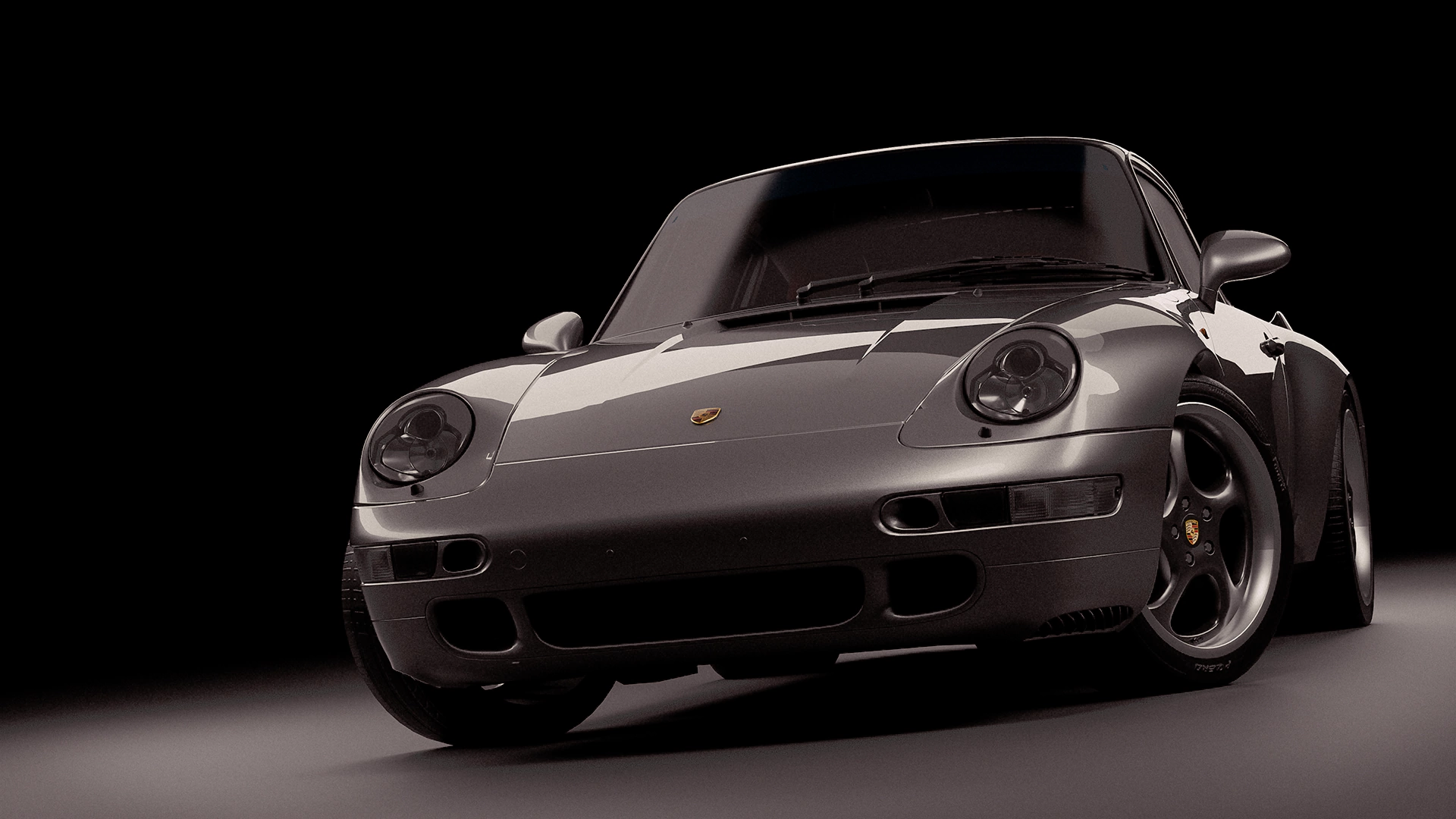
Porsche 993 Turbo 1995 Design Review & Specs
2026-06-23
1995 Porsche 993 Turbo - The Air-Cooled Swan Song
1. Overview
| Manufacturer | Porsche |
| Production | 1994–1998 (Turbo model); 1993–1998 (entire 993 generation) |
| Model Year | 1995–1998 (Turbo) |
| Assembly | Stuttgart-Zuffenhausen, Germany |
| Layout | Rear-engine, rear-wheel drive / all-wheel drive (Turbo) |
| Body Style | 2-door coupé; 2-door targa; 2-door cabriolet |
| Chassis Code | 993 |
| Predecessor | Porsche 964 (Turbo 3.6) |
| Successor | Porsche 996 (Turbo) |
The Porsche 993 represents the final evolution of the air-cooled 911, a lineage that stretched back to 1963. Introduced in 1993 for the 1994 model year, the 993 featured a completely redesigned chassis, a more advanced all-wheel-drive system (on the Turbo), and a design that perfectly captured the essence of the 911—muscular, rounded, and timeless. The Turbo variant, launched in 1995, took that formula and added breathtaking performance, twin-turbocharged power, and widened rear haunches that remain one of the most iconic silhouettes in automotive history.
2. History & Development
2.1 The Final Air-Cooled 911
By the early 1990s, Porsche knew that the air-cooled flat-six engine, while beloved, was reaching its engineering limits. Stricter emissions regulations and noise standards meant that a water-cooled successor was inevitable. The 993 was therefore conceived as both a mechanical high point and a graceful farewell to an era.
Development began in 1989 under the project code "Typ 993." The engineering team, led by August Achleitner, was tasked with creating a 911 that would offer significantly improved handling, braking, and structural rigidity while retaining the essential character of the original. The result was a car that shared almost no body panels with its predecessor, the 964, yet remained instantly recognisable as a 911.
2.2 The Turbo: A Technological Statement
When the 993 Turbo arrived in 1995, it marked a pivotal moment. For the first time in a production 911 Turbo, Porsche equipped the car with all-wheel drive. Borrowing from the 959 supercar, the system (later dubbed "Porsche Traction Management") used a viscous coupling to distribute power between the rear and front axles, providing unprecedented grip and stability. The engine was a twin-turbocharged version of the 3.6-litre air-cooled flat-six, producing 402 bhp in its initial form—more than enough to challenge the era's supercars.
2.3 Design Evolution
The 993's design was led by Harm Lagaay, with exterior design handled by Tony Hatter. The brief was clear: refine the 911 silhouette to its purest, most coherent form. Sharp edges were eliminated; the rear end was made cleaner and more integrated; and the front bumper became a single, unified piece. The design was so successful that it set the standard for all future 911s, influencing the water-cooled generations that followed.
3. Design Team
| Role | Name |
|---|---|
| Chief Designer | Harm Lagaay |
| Exterior Designer | Tony Hatter |
| Interior Designer | (Porsche internal team; heavily inspired by previous generations) |
| Chief Engineer (Project Lead) | August Achleitner |
Harm Lagaay, a Dutch designer who had previously worked at Ford and BMW, joined Porsche in 1989. He oversaw the design of the 993, the Boxster (986), and the 996. Tony Hatter, his exterior designer, had been with Porsche since the late 1980s and was responsible for the 993's sculpted, bulging fenders and seamless body surfaces.
4. Exterior Design Analysis
4.1 Stance & Proportions
| Dimension | Measurement (Turbo) |
|---|---|
| Overall Length | 4,245 mm (167.1 in) |
| Overall Width | 1,835 mm (72.2 in) — Turbo: 1,850 mm (72.8 in) |
| Overall Height | 1,265 mm (49.8 in) — Turbo: 1,290 mm (50.8 in) |
| Wheelbase | 2,272 mm (89.4 in) |
| Front Track | 1,405 mm (55.3 in) |
| Rear Track | 1,515 mm (59.6 in) — Turbo: 1,530 mm (60.2 in) |
| Ground Clearance | ~120 mm (4.7 in) |
The 993's proportions are classic 911: a long rear overhang with the engine mounted behind the rear axle, a short front bonnet, and a fastback roofline that flows directly into the rear. The Turbo widens the rear track significantly—by nearly 30 mm over the Carrera—resulting in the iconic "wide-body" look. The flared rear arches, combined with the enormous rear tyres, give the car a planted, muscular stance that is pure Porsche.
4.2 Bulky Language & Sculpted Volume
The 993 continues the 911 family's vocabulary of bulky, sculpted forms. Apart from a subtle indentation on the front bonnet (which houses the fuel filler cap on some models), there are no sharp corners anywhere. The fenders are organically flared, and the transition from body side to wheel arch is a gentle, sweeping curve. The rear axle is noticeably wider than the front, giving the car a purposeful, rear-biased presence. The design tone is muscular but never aggressive—polished volume, never a sharp crease.
4.3 The Front Fascia & Elliptical Headlights
The front end is dominated by the elliptical headlight units, which are more integrated into the fenders than on any previous 911. The lenses are set into soft, recessed housings that follow the curvature of the body. The front bumper is a single, smooth piece featuring large air intakes for the brakes and oil coolers—functional elements that are shaped with restraint. On the Turbo, additional intakes at the outer edges feed the twin turbochargers, but they are integrated so seamlessly that they never look tacked on.
4.4 The Rear Light Bar & Functional Integration
The rear is perhaps the 993's most defining feature. The taillights run as one uninterrupted strip across the width of the car, a motif Porsche had used sporadically on earlier models but perfected here. This connected light bar serves multiple functions:
- Visual unity: It ties the rear together into a single, calm graphic, reducing visual chaos.
- Aerodynamic function: The rear light housing incorporates the engine air intakes, drawing cool air from the side of the car directly into the engine bay.
- Thermal management: Integrated vents help expel hot air from the engine compartment.
This integration of function and form is quintessential Porsche. Interestingly, three decades later, connected light bars have become a global trend across all automotive segments—a testament to the 993's forward-thinking design.
4.5 The Missing Shoulder Line
Like the Toyota Supra MK4, the 993 deliberately avoids a sharp shoulder crease. The body side is a continuous soft swell that runs from the front wing, over the door, and into the rear haunch. There is no crisp edge to catch the light; instead, the surface rises and falls gently, creating a subtle highlight that travels the length of the car. The result is a cohesive, monolithic form that looks right from every angle—a pure expression of proportion, as Pininfarina famously noted.
4.6 Wheel Design (Turbo)
| Wheel Size (Turbo) | 8J x 18 front, 10J x 18 rear |
| Tyres (Turbo) | 225/40ZR18 front, 285/30ZR18 rear |
The 993 Turbo's wheels are a masterpiece of subtle dynamism. The design features five twisted spokes that introduce a rotational motif around the centre, suggesting speed even when stationary. The spokes remain thick and soft-edged, however, completely consistent with the body's bulky language—no sharp edges, no visual clash. The large rear wheels, wrapped in 285-section tyres, fill the cavernous rear arches and reinforce the car's aggressive-but-refined stance.
5. Interior Design
5.1 Classic 911 Cockpit
The interior of the 993 is a refined version of the classic 911 cockpit that had evolved over three decades. The dashboard is driver-focused, with the five principal gauges (tachometer, speedometer, and ancillary dials) placed directly ahead of the driver. The tachometer sits centrally, emphasising the driving experience. The steering wheel is a chunky, three-spoke design, and all controls are within easy reach.
5.2 Ergonomics & Layout
- Compact and purposeful: Everything is angled toward the driver. The centre console is simple, with controls for heating, ventilation, and audio arranged in a logical, uncluttered manner.
- Two-tone colour combinations: A subtle but effective design choice. By using contrasting colours for the dashboard, door panels, and seats, Porsche visually breaks up the mass of the cabin. This makes the compact cockpit feel slightly larger and more open—a clever piece of design psychology.
- Seating: The seats are supportive but not overly aggressive, offering a balance between sportiness and long-distance comfort. Many models featured optional electric adjustment and heating.
5.3 Material Quality
Porsche used high-quality materials—leather, soft-touch plastics, and metal trim—that have aged remarkably well. The interior feels substantial and durable, a reflection of Porsche's engineering ethos.
5.4 Practicality
While not a practical car by any modern standard, the 993 offers a surprisingly usable front luggage compartment and a small rear parcel shelf. For the Turbo, the rear seats are present but effectively vestigial, better suited for luggage than passengers.
6. Chassis & Suspension
6.1 Revolutionary Chassis
The 993 featured a significantly redesigned chassis compared to the 964. The rear suspension was completely overhauled, moving from the semi-trailing arm design (used since the original 911) to a multi-link system—the "Weissach axle." This reduced rear-end squat under acceleration and improved stability, making the car far more predictable and forgiving.
6.2 Suspension & Brakes
| Component | Specification |
|---|---|
| Front Suspension | MacPherson strut with lower wishbone, coil springs, stabiliser bar |
| Rear Suspension | Multi-link (Weissach axle) with coil springs, stabiliser bar |
| Front Brakes | 4-piston monobloc calipers, 304 mm ventilated discs (Turbo: 330 mm) |
| Rear Brakes | 4-piston monobloc calipers, 299 mm ventilated discs (Turbo: 322 mm) |
| Brake Assist | ABS standard |
| Brake System | Dual-circuit, hydraulic, with vacuum booster |
The 993 Turbo introduced Porsche's "Big Red" brake system with cross-drilled discs, providing fade-resistant stopping power to match its immense speed.
6.3 All-Wheel Drive System (Turbo)
| Component | Specification |
|---|---|
| Drive Type | Permanent all-wheel drive |
| Centre Differential | Viscous coupling with 20% front / 80% rear torque split (variable up to 50/50) |
| Rear Differential | Mechanical limited-slip differential (40% locking) |
The viscous coupling is located in the front differential housing. In normal driving, it sends 20% of power to the front wheels and 80% to the rear—preserving the rear-biased handling character of a 911. When rear wheels lose traction, the coupling locks progressively, sending up to 50% of torque forward.
6.4 Weight & Balance
| Carrera (RWD) | Turbo (AWD) | |
|---|---|---|
| Curb Weight | 1,370 kg (3,020 lb) | 1,470 kg (3,241 lb) |
| Weight Distribution | ~40% Front / 60% Rear | ~39% Front / 61% Rear |
The rear-heavy distribution is a hallmark of the 911. While it can be challenging at the limit, the 993's advanced suspension and AWD system on the Turbo made it far more accessible than its predecessors.
6.5 Steering
| Component | Specification |
|---|---|
| Type | Rack and pinion, power-assisted |
| Turning Radius | ~10.8 m (35.4 ft) |
7. Engine & Performance
7.1 The Air-Cooled Flat-Six
The 993 Turbo is powered by the last great air-cooled Porsche engine—a twin-turbocharged evolution of the M64 series. Unlike the Carrera's naturally aspirated unit, the Turbo's engine features:
- Twin KKK K16 turbochargers with intercoolers
- Lower compression ratio to accommodate forced induction
- Larger displacement (3.6 litres) over the earlier 3.3-litre Turbo
7.2 Engine Specifications (Turbo)
| Specification | Detail |
|---|---|
| Engine Code | M64.60 (Turbo) |
| Configuration | Flat-6, 24-valve SOHC, air-cooled (with oil coolers) |
| Displacement | 3,600 cc (219.7 cu in) |
| Bore × Stroke | 100.0 mm × 76.4 mm |
| Compression Ratio | 8.0:1 |
| Turbocharger | Twin KKK K16, with air-to-air intercoolers |
| Fuel System | Bosch Motronic electronic fuel injection |
| Fuel Tank Capacity | 75 L (19.8 US gal) |
7.3 Power Output
| 1995 Turbo | 1998 Turbo S | |
|---|---|---|
| Maximum Power | 408 PS (300 kW; 402 bhp) @ 5,750 rpm | 450 PS (331 kW; 444 bhp) |
| Maximum Torque | 541 N·m (399 lb·ft) @ 4,500 rpm | 586 N·m (432 lb·ft) |
| Redline | 6,400 rpm | 6,400 rpm |
7.4 Transmission
| Component | Specification |
|---|---|
| Type | 6-speed manual |
| 1st | 3.818 |
| 2nd | 2.150 |
| 3rd | 1.560 |
| 4th | 1.211 |
| 5th | 0.970 |
| 6th | 0.769 |
| Reverse | 3.333 |
| Final Drive | 3.444 |
A 4-speed Tiptronic automatic was available on the Carrera but not on the Turbo (except for special orders in later years).
7.5 Performance Figures (Turbo, 6MT)
| Metric | Value |
|---|---|
| 0–60 mph | 4.2 seconds |
| 0–100 mph | 9.0 seconds |
| Quarter mile | 12.5 seconds @ 114 mph |
| Top Speed | 184 mph (296 km/h) |
| Fuel Economy (combined) | ~18 mpg (US) |
| CO₂ Emissions (estimated) | ~330 g/km |
8. Complete Specifications (1995 993 Turbo)
Dimensions
| Overall Length | 4,245 mm (167.1 in) |
| Overall Width | 1,850 mm (72.8 in) |
| Overall Height | 1,290 mm (50.8 in) |
| Wheelbase | 2,272 mm (89.4 in) |
| Front Track | 1,405 mm (55.3 in) |
| Rear Track | 1,530 mm (60.2 in) |
| Ground Clearance | 120 mm (4.7 in) |
Weights & Capacities
| Curb Weight | 1,470 kg (3,241 lb) |
| Gross Vehicle Weight | 1,800 kg (3,968 lb) |
| Seating Capacity | 2+2 |
| Front Luggage Compartment Volume | 100 L (3.5 cu ft) |
Engine & Performance Summary
| Metric | Value |
|---|---|
| Engine | M64.60 twin-turbo flat-6, air-cooled |
| Power | 408 PS (402 bhp) |
| Torque | 541 N·m (399 lb·ft) |
| Transmission | 6-speed manual |
| Drive | Permanent all-wheel drive |
| 0‑60 mph | 4.2 seconds |
| Top Speed | 184 mph |
9. Variants & Evolution
9.1 993 Lineup Overview
| Model | Years | Engine | Power | Drive |
|---|---|---|---|---|
| Carrera | 1994–1998 | 3.6L flat-6 (NA) | 272 PS (268 bhp) | RWD |
| Carrera 4 | 1994–1998 | 3.6L flat-6 (NA) | 272 PS (268 bhp) | AWD |
| Carrera S | 1997–1998 | 3.6L flat-6 (NA) | 286 PS (282 bhp) | RWD (wide-body) |
| Carrera 4S | 1997–1998 | 3.6L flat-6 (NA) | 286 PS (282 bhp) | AWD (wide-body) |
| Turbo | 1995–1997 | 3.6L flat-6 (TT) | 408 PS (402 bhp) | AWD |
| Turbo S | 1997–1998 | 3.6L flat-6 (TT) | 424–450 PS (418–444 bhp) | AWD |
9.2 Turbo S (1998)
A limited-edition (and final-year) variant with:
- Larger turbochargers and upgraded intercoolers
- 450 PS (444 bhp) in its ultimate form
- Distinctive "flared" front air intakes
- Carbon-fibre interior trim
- Larger brakes with yellow calipers
- Only 345 units built
9.3 993 Targa
An interesting variant with a glass roof that slides open under the rear window. It preserved the 993's silhouette while offering an open-air experience without sacrificing structural integrity.
9.4 Carrera RS & GT2
- Carrera RS: Lightweight, rear-wheel-drive, naturally aspirated track-focused model. 300 PS (296 bhp), stripped interior, limited to about 1,000 units.
- GT2: The ultimate 993—rear-wheel-drive, twin-turbo, wide-body, stripped interior, massive rear wing, and up to 450 bhp. A homologation special for GT2 racing, with only around 200 road-going units built.
10. Cultural Impact & Legacy
10.1 The Last of the Air-Cooled Icons
The 993 is often described as a turning point—the last air-cooled 911, the bridge to a new era. Enthusiasts have long debated the merits of air-cooled versus water-cooled, but there is near-universal agreement that the 993 represents the peak of the air-cooled design. The sound of its flat-six, with its distinctive fan whir and mechanical symphony, is an acoustic signature that cannot be replicated.
10.2 Design Perfection
From a design perspective, the 993 is more than just a swan song. It's the moment the 911 silhouette reached a level of polish that still looks current today. No sharp corners, no trend-chasing—just proportion, surface discipline, and signature forms refined over 30 years. The connected rear light bar, the flawless integration of functional elements, and the bulging, organic fenders are now considered the gold standard for Porsche design.
10.3 Influence on Subsequent Generations
The 993's design language directly influenced the water-cooled 996 and 997 that followed. The elliptical headlights, the smooth rear section, and the overall volumetric approach were carried over, albeit with modernisation. Even the latest 992 generation still pays homage to the 993's clean rear treatment and integrated light bar.
10.4 Market Status
The 993 Turbo, especially in its manual transmission guise, has become a highly desirable collectible. Prices have risen steeply over the last decade, with pristine examples commanding well over $200,000–$300,000. The Turbo S is even rarer and more valuable, sometimes surpassing $500,000. This appreciation is a testament to the car's enduring appeal and its status as a design icon.
10.5 Why It's Still Endearing
The 993 is adored not just because it's rare or fast, but because it feels honest. It communicates its intentions clearly, both inside and out. The design trusts the purity of the silhouette, the bulge of the fenders, and the calmness of the light graphics to do the talking. That honesty, combined with the nostalgic romance of the air-cooled engine, ensures the 993 will forever be cherished.
11. Poster
Download the official Asphalt Aesthetics Episode 1 poster: